Last updated: September 22, 2026. Benchmark figures come from the September 16, 2026 run of the Web Data Frontier Benchmark. Pricing was checked against each vendor's published pages on September 21 and 22, 2026.
The best e-commerce scraping API in 2026 is String, which returned content on 95.8% of requests across the 43 retail, fashion, marketplace and grocery sites in the September 16, 2026 benchmark run. Scrapfly and ScraperAPI tied for second at 82.8%, and ScraperAPI got there almost four times faster. Firecrawl placed fourth at 80.5%, Oxylabs fifth at 74.0%, Apify sixth at 72.1%, ScrapingBee seventh at 71.6% and Bright Data eighth at 70.2%. The number that decides a price monitor, though, is not the headline rate. It is how much a provider's score changes between one kind of shop and another, and for the median provider in this field that swing is 26.5 points.
Success is the share of 215 requests that came back with real page content. The e-commerce path rate is what each vendor's own published rules charge for a protected retail page, at the plan nearest $100 a month billed monthly.
| API | E-commerce success | Full returns, of 43 sites | Median time per site | Plan at ~$100 | E-commerce path, per 1,000 | The catch |
|---|---|---|---|---|---|---|
| String | 95.8% | 38 | 4.1s | Growth, $100 | $2.00 premium | No dedicated retail endpoint, and no SOC 2 report yet |
| Scrapfly | 82.8% | 28 | 19.6s | Pro, $100 | $2.50 residential | Slowest median of the top four; credits do not roll over |
| ScraperAPI | 82.8% | 27 | 5.4s | none; $49 or $149 | $1.639 protected, $0.745 Amazon | Bills every request, success or not; partial on 13 sites |
| Firecrawl | 80.5% | 31 | 7.2s | Standard, $99.50 | $0.995 flat | Bills a returned 403 or 404; six shutouts |
| Oxylabs | 74.0% | 29 | 8.6s | Starter, $99 | $0.45 Amazon, $1.30 with JS | 220,000 results a month is the Starter ceiling |
| Apify | 72.1% | 25 | 19.1s | none; $19 or $199 | $1.00 Web Fetch | Prepaid usage expires monthly; a converted 404 still bills |
| ScrapingBee | 71.6% | 23 | 19.5s | Startup, $99 | $2.475 premium with JS | Its own docs route e-commerce to the 25-credit tier |
| Bright Data | 70.2% | 25 | 11.5s | none; $1.50 or $499 | $1.50 | No plan between the free tier and $499 |
Eight more APIs ran the same 43 sites and are not profiled here, because their e-commerce rates put them outside a serious shortlist: Context.dev 68.8%, Zyte 64.2%, Decodo 61.4%, Nimble 60.9%, ZenRows 55.3%, Scrapingdog 46.5%, Browserbase 34.9% and ScrapingAnt 33.0%.
The Web Data Frontier Benchmark ran on September 16, 2026. It calls 16 scraping APIs against 100 bot-protected sites, five attempts each, 500 requests per provider, with a 90-second timeout. A request counts as a success only when the response carries the target page's real content. A challenge page, an empty shell, a block page and a timeout all count as failures, which is why several vendors score far below the uptime figures on their own sites.
This page scores a subset. Of the 100 targets, 43 sit in four e-commerce groups: Retail and ecommerce (17 sites), Fashion and luxury (11), Marketplaces and classifieds (10), and Grocery and food (5). That is 215 requests per provider. The groups come from the industry field each target carries in the harness, so the split is the harness's, not ours.
One caveat belongs next to every rank on this page. The September 16 run is the first where every provider ran at its strongest published setting, and several had been running below it before. ScraperAPI moved from 64.2% to 84.0% overall between the August and September runs, and ScrapingBee from 29.7% to 73.0%. Those jumps measure our adapters catching up more than they measure a product change. Their September numbers are the fair ones; their August numbers were not.
Before any of these numbers mean anything, the honest objection: you may not need to buy anything. On r/webscraping in May 2025, a practitioner running price collection at industrial volume put the ceiling of the cheap approach plainly.
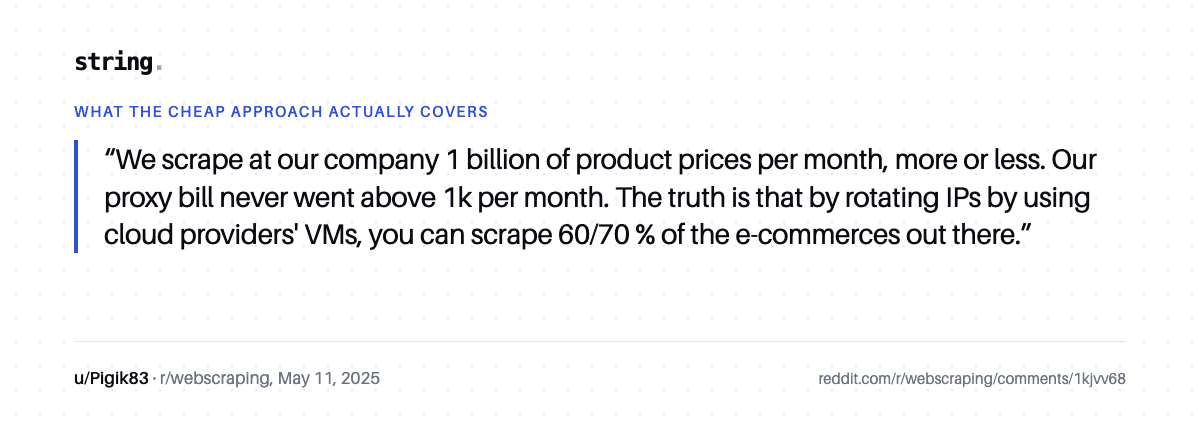
That is the right frame for this page. Rotating cloud IPs gets you most of the catalogue for almost nothing. The 43 sites in this benchmark are the other 30 to 40%: the ones that carry DataDome, Akamai or a self-built wall, and the ones a scraping API exists to reach. Every rate below is a rate on that hard tail, not on e-commerce as a whole.
A shortlist built on one headline number assumes a provider is equally good at Amazon, at Louis Vuitton, at eBay and at Kroger. Almost none of them are. Score the 16 providers on the four e-commerce groups separately and the median provider's best group beats its worst by 26.5 points. Eleven of the 16 swing by more than 20 points inside e-commerce alone.
| API | Retail | Fashion | Marketplaces | Grocery | Spread |
|---|---|---|---|---|---|
| String | 92.9% | 98.2% | 96.0% | 100% | 7.1 |
| Bright Data | 67.1% | 72.7% | 70.0% | 76.0% | 8.9 |
| Firecrawl | 76.5% | 85.5% | 82.0% | 80.0% | 9.0 |
| ScrapingAnt | 38.8% | 27.3% | 30.0% | 32.0% | 11.5 |
| Zyte | 62.4% | 70.9% | 66.0% | 52.0% | 18.9 |
| ScraperAPI | 74.1% | 89.1% | 84.0% | 96.0% | 21.9 |
| Nimble | 49.4% | 65.5% | 70.0% | 72.0% | 22.6 |
| Scrapfly | 71.8% | 80.0% | 98.0% | 96.0% | 26.2 |
| Apify | 61.2% | 74.5% | 80.0% | 88.0% | 26.8 |
| ZenRows | 50.6% | 70.9% | 54.0% | 40.0% | 30.9 |
| Oxylabs | 68.2% | 74.5% | 70.0% | 100% | 31.8 |
| Browserbase | 36.5% | 27.3% | 28.0% | 60.0% | 32.7 |
| Scrapingdog | 37.6% | 52.7% | 42.0% | 72.0% | 34.4 |
| Context.dev | 67.1% | 65.5% | 60.0% | 100% | 40.0 |
| Decodo | 55.3% | 83.6% | 58.0% | 40.0% | 43.6 |
| ScrapingBee | 83.5% | 47.3% | 66.0% | 96.0% | 48.7 |
ScrapingBee is the clearest case. It is second of 16 on plain retail at 83.5%, behind only String and ahead of Firecrawl and ScraperAPI, and fourteenth on fashion and luxury at 47.3%. Evaluate it on Amazon and Walmart and you will buy it. Point it at Zara and Saks and half your rows go missing. Decodo runs the other way: 83.6% on fashion, fourth of 16, and 40.0% on grocery, joint fourteenth.
This is why a two-site trial tells you almost nothing. If your catalogue crosses groups, test across groups.
Difficulty in e-commerce is not spread evenly. Most of the 43 sites open for most providers. A short list of them opens for almost nobody, and those are the ones that decide whether a crawl is complete.
| Site | Group | Field average | Returned all five attempts |
|---|---|---|---|
| temu.com | Retail | 0% | nobody |
| mouser.com | Retail | 25.0% | String, Firecrawl |
| allegro.pl | Marketplaces | 25.0% | Scrapfly, Nimble, ZenRows |
| autozone.com | Retail | 35.0% | String, Firecrawl |
| us.louisvuitton.com | Fashion | 37.5% | String, Scrapfly, Firecrawl, Decodo |
| saksfifthavenue.com | Fashion | 38.8% | String, Scrapfly, ScraperAPI, Oxylabs, ZenRows |
| coupang.com | Retail | 38.8% | Firecrawl, ScrapingBee |
| cargurus.com | Marketplaces | 38.8% | String, Scrapfly, Firecrawl, Bright Data |
| neimanmarcus.com | Fashion | 43.8% | String, Scrapfly, ScraperAPI, Apify, Bright Data |
| bestbuy.com | Retail | 45.0% | String, ScrapingBee, Context.dev, Oxylabs |
temu.com returned nothing to anyone, across 80 requests. It did the same on August 11, when all fifteen providers then in the field returned nothing from it. No provider on this page can get you Temu, and a vendor who tells you otherwise should be asked for a live demonstration.
allegro.pl and coupang.com are the two sites where String is beaten outright. Poland's largest marketplace went to Scrapfly, Nimble and ZenRows in full; String returned four of five. Coupang went to Firecrawl and ScrapingBee; String again returned four of five. Two more, footlocker.com and autotrader.com, also cost String a fifth attempt while eight or nine other providers cleared them.
Best Buy is the sharpest illustration of the spread argument. Four providers returned it in full, and the four are String, ScrapingBee, Context.dev and Oxylabs. Three of those four rank eighth or lower overall.
A blocked request is loud. You see the error, you retry, you move on. The failure that damages a price history is quieter: the site comes back on three attempts out of five and nothing on the other two. If you need price history from before you started collecting, see how to get historical website data.
Retail sites are unusually good at producing that quiet failure, because several of them strip the data rather than refuse the request.
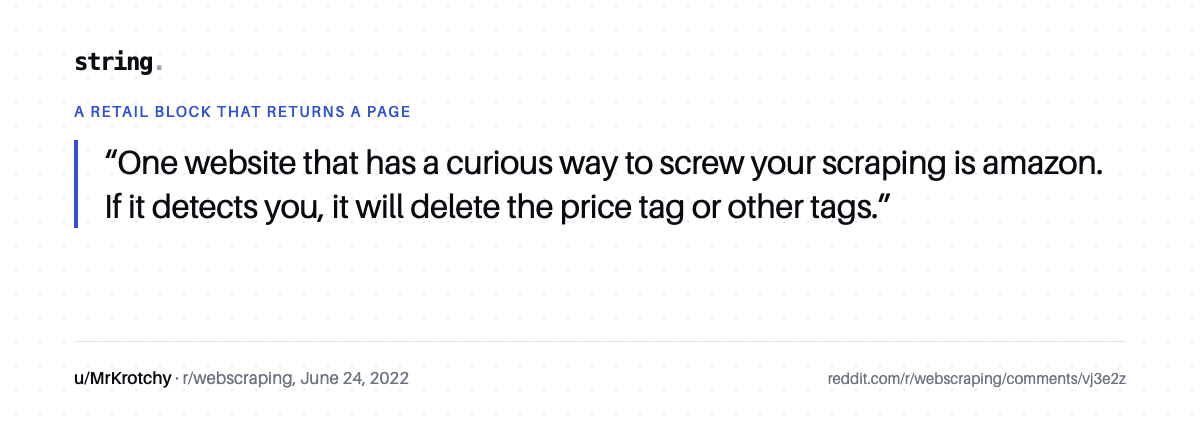
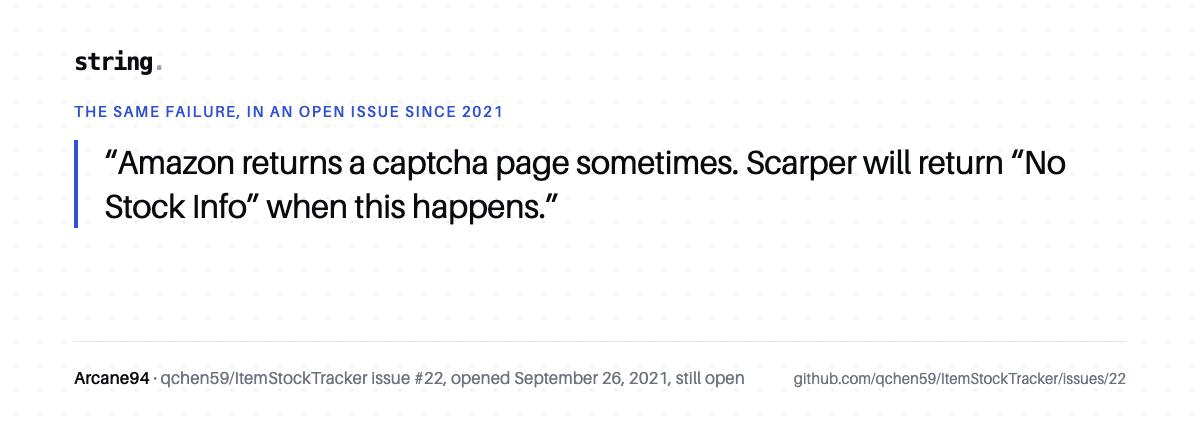
A 200 response with the price removed does not look like a block to any code you have written. It looks like a product with no price. The same failure shows up in open-source trackers: in issue #22 on the ItemStockTracker project, opened in September 2021 and still open today, the reporter describes an Amazon captcha page that arrives intermittently and the tracker recording "No Stock Info" in its place.
On the 43 e-commerce sites, here is how each provider's attempts split.
| API | All five | Partial | None |
|---|---|---|---|
| String | 38 | 4 | 1 |
| Firecrawl | 31 | 6 | 6 |
| Oxylabs | 29 | 6 | 8 |
| Scrapfly | 28 | 11 | 4 |
| ScraperAPI | 27 | 13 | 3 |
| Context.dev | 27 | 6 | 10 |
| Apify | 25 | 11 | 7 |
| Bright Data | 25 | 10 | 8 |
| Zyte | 24 | 5 | 14 |
| ScrapingBee | 23 | 12 | 8 |
| Nimble | 21 | 8 | 14 |
| Decodo | 19 | 11 | 13 |
| ZenRows | 18 | 11 | 14 |
| Browserbase | 12 | 5 | 26 |
| Scrapingdog | 9 | 21 | 13 |
| ScrapingAnt | 8 | 11 | 24 |
Scrapingdog is the shape to watch. It returned something on 30 of the 43 sites, which sounds fine, and returned all five attempts on only 9. Nearly half its sites are partial. Run a daily price collection on that and two runs of the same job disagree with each other with no code change in between, and the gaps land in whichever SKUs happened to fail that morning. A dashboard built on it does not look broken. It looks slightly wrong, in a different place each day.
Across the whole field, 21.9% of the 688 provider and site pairs in the e-commerce set were partial. The same measure across all 100 benchmark sites is 18.7%. E-commerce is the flakiest part of the run.
Retail sites run the heaviest bot protection on the open web, because scraping them has direct commercial value to a competitor. The four vendors that cover most of the set are Cloudflare, whose own docs describe four detection engines feeding one bot score, DataDome, Akamai Bot Manager and HUMAN, formerly PerimeterX. The benchmark records which vendor protects each target, and the field-wide table below covers all 100 sites rather than the 43 here, so read it as context rather than as an e-commerce ranking.
DataDome is the most common wall in the run at 19 sites, and it separates the field hardest: String and Scrapfly both returned 92.6% of DataDome requests, ScraperAPI 82.1%, and ScrapingAnt 4.2%. Akamai covers 20 sites, where String returned 98.0%, ScraperAPI 92.0% and Firecrawl 84.0%.
If your target list is mostly US big-box retail, the DataDome column is the one to read first.
These walls are not a theoretical tax. Camoufox, one of the better open-source stealth browsers, carries an issue in which a DataDome-protected classifieds site blocks it on every attempt while the same IP loads the page fine in a private browser tab. On the retail side, an MCP server built specifically to read Walmart has an open issue from July 2026 reporting that its headless sessions are blocked by Walmart's bot detection even when the session is authenticated. Both are the ordinary condition, not edge cases, and they are the reason this benchmark scores content returned rather than requests sent.
String returned 206 of 215 e-commerce requests. It cleared 38 of the 43 sites on all five attempts, shut out on one, and left four partial. Its four group scores are 92.9%, 98.2%, 96.0% and 100%, which is a spread of 7.1 points, the narrowest in the run. Median time per site was 4.1 seconds, also the fastest of the eight.
The product is one fetch endpoint. String's docs set the escalation as search, then fetch, then a browser session. You send a URL, you get content, and billing counts only the requests that come back with content. The Growth plan is $100 a month at $0.20 per 1,000 standard fetches and $2.00 per 1,000 on the premium path, which is where protected retail pages land. Credits roll over. The first 5,000 standard requests need no card.
Where it loses: allegro.pl, coupang.com, footlocker.com and autotrader.com each cost it a fifth attempt, and temu.com returned nothing. There is no dedicated Amazon or product-catalogue endpoint. For structured product fields, read the JSON-LD the page already carries or send a JSON Schema with the fetch; which scraping API returns clean structured JSON tests both on these sites. The Enterprise rate card is not published, so you cannot verify the high-volume price from a public page. String has no SOC 2 report.
Full method and per-site results.
Scrapfly returned 178 of 215, and it is the only provider on this page that beats String in an e-commerce group: 98.0% on marketplaces and classifieds against String's 96.0%. It also took allegro.pl in full, which String did not. Retail is its weak group at 71.8%.
Pro is $100 a month for 1,000,000 credits. An HTTP scrape on a datacenter IP is 1 credit, so $0.10 per 1,000. JavaScript rendering or the Unblocker is 5 credits, and residential proxies are 25, which is $2.50 per 1,000 on the path most protected retail pages need. Failed requests are never charged. Quotas reset at renewal with no rollover.
One thing to check before you budget. The credit table on Scrapfly's pricing page prices the Unblocker at 5 credits, and the sample API response further down the same page shows "asp_cost": 30 on a request with "asp": true. Those two numbers are hard to reconcile. Ask their support which applies to your traffic.
The cost is time. Scrapfly's median per site on the e-commerce set was 19.6 seconds, against ScraperAPI's 5.4 for the same number of successes. On a nightly batch that is irrelevant. On anything a user waits for, it is not. More on Scrapfly's speed profile.
ScraperAPI also returned 178 of 215, at a median of 5.4 seconds per site. On fashion and luxury it is second of 16 at 89.1%, and on grocery it is joint fourth at 96.0%. Plain retail is its weakest e-commerce group at 74.1%.
It is also the vendor whose pricing an e-commerce buyer most needs to read carefully, because ScraperAPI is the one that prices by domain. Its own documentation: "A standard page costs 1 credit. Amazon costs 5, Google and Bing (including their subdomains) cost 25, and LinkedIn costs 30. Sites behind bot protection like Cloudflare, Datadome, or PerimeterX add 10 credits per request when we bypass them."
There is no $100 plan. Hobby is $49 for 100,000 credits and Startup $149 for 1,000,000, which is $0.149 per 1,000 credits. At that rate an Amazon page is $0.745 per 1,000 and a protected retail page is $1.639 per 1,000, eleven times the plain rate. Credits do not roll over, and max_cost caps what any single request can spend.
ScraperAPI also bills every request, not only the ones that return content, which is unusual in this field now. And it left 13 of the 43 sites partial, the highest count among the eight profiled here. Where ScraperAPI sits against the rest.
Firecrawl returned 173 of 215, and it cleared 31 of 43 sites on all five attempts, second only to String. It is one of two providers that took mouser.com and autozone.com in full, both sites where the field averaged under 35%.
Its pricing is the simplest here. One credit is one page, with no proxy class, no anti-bot surcharge and no per-domain multiplier. Standard is $83 a month billed annually, which is $99.50 billed monthly, for 100,000 credits: $0.995 per 1,000 pages whatever the site. Firecrawl's pricing page shows annual prices by default, so read the toggle before you compare it with anything; the machine-readable version states the same rates without the toggle.
Read the billing rule carefully, though. A scrape that returns no result is not charged, but a page that answers with a 403 or a 404 is returned to you and costs a credit, so a wall that serves a polite error is billable. Firecrawl also shut out entirely on six of the 43 sites, more than String, Scrapfly or ScraperAPI. Firecrawl's full profile.
Oxylabs returned 159 of 215. Its grocery score is 100%, joint first with String and Context.dev, and its retail score is 68.2%, sixth of 16. That 31.8-point spread is the sixth-widest in the run.
It is the one vendor here that makes a named retail site cheaper rather than dearer. On the Starter plan at $99 a month, Amazon results are $0.45 per 1,000, Google $0.90, and everything else $1.10, with JavaScript rendering at $1.30. Only successful results are billed. VAT may apply.
The limits are volume and a price the site advertises but does not sell. Starter tops out at 220,000 results a month, and the Regular ladder ends at Advanced, 622,500 results, above which you are in a sales conversation. And the navigation card on Oxylabs' own product page advertises "Starts from $0.25 /1K results", a rate the Regular pricing tab never shows; its lowest published figure is $0.40 per 1,000 for Amazon on the Advanced plan. Web Unblocker is a separate product billed per gigabyte, not per result. Oxylabs alternatives.
Apify returned 155 of 215 through its adapter in the run. Grocery is its best group at 88.0% and retail its worst at 61.2%.
Apify is not shaped like the rest of this list. It is a marketplace of 72,447 Actors, which are prebuilt scrapers you rent, plus a general fetch path. Its anti-blocking page puts the promise plainly: "If we get blocked, we try again, but we charge you only for valid output." For e-commerce the marketplace is the real argument: someone has usually already written the Amazon or Shopify scraper you need, and it returns structured fields rather than page content.
The general path is Web Fetch, priced from $1.00 per 1,000 fetches on pay-per-event billing, charged only on a successful fetch, with retries inside a single request free. Fetches route through Apify Proxy's Unblocker group, which escalates to a real browser when a page needs one, and the underlying crawler is the open-source Crawlee. Note the edge: if a site answers with a 404 page and Web Fetch converts it to Markdown, that counts as a successful fetch and bills. There is no $100 plan. Starter is $19 a month and Scale $199, and the plan fee is itself spendable usage, so $100 of monthly spend buys about 100,000 fetches. Unused prepaid usage expires at the end of the billing cycle rather than rolling over.
We cannot tell you which Apify product the harness called in the September run, because the adapter lives in the benchmark repo rather than in the published data. Treat 72.1% as Apify's adapter, not as a named product's rate.
ScrapingBee returned 154 of 215, and it owns the widest spread in the field. Retail 83.5%, second of 16. Fashion and luxury 47.3%, fourteenth. Grocery 96.0%. Marketplaces 66.0%.
Its credit ladder is the clearest statement any vendor on this page makes about e-commerce. From its own documentation: hard-to-scrape e-commerce websites need premium_proxy=true, which costs 10 credits without JavaScript rendering and 25 with it. The Startup plan is $99 a month for 1,000,000 credits, so $0.099 per 1,000 credits. A plain page is $0.099 per 1,000. The premium-with-JavaScript path that its docs send retail to is $2.475 per 1,000, twenty-five times as much. Stealth with JavaScript is 75 credits, $7.425 per 1,000. Prices exclude VAT.
Auto-Mode is the mitigation and it is a good one. Set mode=auto and ScrapingBee tries configurations cheapest first, charges only for the one that worked, and charges zero if all of them fail. max_cost caps how far it will climb.
ScrapingBee also ships dedicated Amazon, Walmart, Home Depot and Costco endpoints, which none of the benchmark's general adapters exercise. If your list is one or two large US retailers, those are worth a trial that this benchmark does not measure.
Bright Data returned 151 of 215. Its four group scores are within 9 points of each other, the second-narrowest spread in the field after String, so it is consistent. It is consistently eighth.
Web Unlocker is pay as you go at $1.50 per 1,000 requests, or $499 a month on Scale for 383,000 requests included and $1.30 per 1,000 after. There is nothing between the 5,000-request free tier and $499. You pay only for success, and concurrency is not capped.
The same disclosure as Oxylabs applies here: Bright Data's navigation advertises "Starts from $1/1k req" and the Web Unlocker pricing page's lowest published rate is $1.30. Bright Data alternatives.
At the plan nearest $100 billed monthly, and on the path each vendor's own rules apply to a protected retail page.
| API | Plan | Plain page, per 1,000 | E-commerce path, per 1,000 | Billed on success |
|---|---|---|---|---|
| ScrapingBee | Startup, $99 | $0.099 | $2.475 | yes, and zero when Auto-Mode fails |
| Scrapfly | Pro, $100 | $0.10 | $2.50 | yes |
| ScraperAPI | none; $49 or $149 | $0.149 | $1.639 | no |
| String | Growth, $100 | $0.20 | $2.00 | yes |
| Oxylabs | Starter, $99 | $1.10 | $1.30 with JS, $0.45 Amazon | yes |
| Firecrawl | Standard, $99.50 | $0.995 | $0.995 | a returned 403 or 404 bills |
| Apify | none; $19 or $199 | $1.00 | $1.00 | a converted 404 bills |
| Bright Data | none; $1.50 or $499 | $1.50 | $1.50 | yes |
Two observations rather than a ranking. First, the cheap headline rates and the e-commerce rates are different products: ScrapingBee's plain page is the cheapest number in the table and its retail path is the dearest but one. Second, six of the eight now bill only for a successful return, so the cost of a failed request is mostly not the bill. It is the missing row, and the hours someone spends finding out which SKU it belonged to.
String, on the September 16, 2026 benchmark. It returned 95.8% of requests across the 43 e-commerce sites and returned 38 of the 43 on all five attempts, both the highest in the run. For price monitoring, the second figure matters more than the first: a site that returns three times out of five leaves holes in a price history that nothing downstream flags. String's spread across retail, fashion, marketplaces and grocery is 7.1 points, the narrowest of 16 providers, so its score does not change much when your catalogue does.
If the prices are page content, use a general fetch API: String at 95.8%, Scrapfly or ScraperAPI at 82.8%, Firecrawl at 80.5%. If you want structured product fields without writing a parser, use Apify and rent a prebuilt Actor for the site. If your list is one or two large US retailers, ScrapingBee and Oxylabs both sell site-specific endpoints that a general benchmark does not measure.
Check the ceiling on the plan, not the headline rate. Oxylabs' Starter plan caps at 220,000 results a month and its Regular ladder ends at 622,500. Bright Data has nothing between a 5,000-request free tier and $499 a month. ScraperAPI and Scrapfly publish million-credit plans, but a protected retail page costs 11 credits on ScraperAPI and 25 on Scrapfly, so a million credits is not a million retail pages. String's Growth plan names no monthly ceiling, and its Enterprise rate card is not published.
Amazon returned 5 of 5 to nine of the 16 providers in the September run, with a field average of 75%, so it is not among the harder retail sites. Price it carefully, though, because two vendors charge a specific Amazon rate and they move in opposite directions. ScraperAPI charges 5 credits for an Amazon page against 1 for a standard page. Oxylabs charges $0.45 per 1,000 Amazon results against $1.10 for everything else.
Reviews sit behind the same walls as the product pages, so the provider choice is the same, but the volume is higher and the pages are paginated. That makes the partial-return rate the number to weigh. Across the e-commerce set, 21.9% of provider and site pairs returned content on some attempts and nothing on others. At review volumes, a partial rate near half, as Scrapingdog's 21 of 43 sites is, produces a corpus with silent gaps rather than obvious errors.
Dependability on large retail sites is not the same as a good overall score. Best Buy, at a field average of 45.0%, was returned in full by String, ScrapingBee, Context.dev and Oxylabs, and three of those four rank eighth or lower overall. Mouser and AutoZone, both under 35%, went only to String and Firecrawl. Build a shortlist from your own target list rather than from a leaderboard, and include at least one site from each group you care about.
The constraint is latency rather than coverage, because a person is waiting. Median time per e-commerce site was 4.1 seconds for String and 5.4 for ScraperAPI, against 19.6 for Scrapfly, 19.5 for ScrapingBee and 19.1 for Apify. A four-times difference in median time changes what the interface can promise. Pick from the fast pair, cache aggressively, and accept that temu.com will not be in your results no matter what you buy.
Completeness and repeatability, in that order, because an incomplete panel is worse than a small one. String returned 38 of 43 sites in full and Firecrawl 31. Then check the four sites where String does not: allegro.pl, coupang.com, footlocker.com and autotrader.com. If any of them is in your panel, run a second provider for those sites rather than switching. Running two APIs is a reasonable end state, and both of ours are free to test: String gives 5,000 standard requests with no card, and Firecrawl 1,000 credits a month.
Benchmark figures: Web Data Frontier Benchmark, September 16, 2026 run, 100 targets, 16 providers, 500 requests each. Harness and raw results: github.com/usestring/web-data-frontier-benchmark.
Pricing, checked September 21 and 22, 2026: String, Scrapfly, ScraperAPI and its credit documentation, Firecrawl, Oxylabs, Apify and Web Fetch, ScrapingBee and its API documentation, Bright Data Web Unlocker.
Practitioner sources, read September 22, 2026: u/Pigik83 on scraping volume and proxy cost, u/MrKrotchy on Amazon removing price tags, ItemStockTracker issue #22, camoufox issue #258, mcp-walmart issue #1. Quote cards reproduce the verbatim text; each links to the original.
Related: Best web scraping tools in 2026, Firecrawl alternatives, ScraperAPI alternatives, Oxylabs alternatives, Bright Data alternatives, all comparisons.